Fitness Professionals
Inclusive Fitness Starts With You
Supporting participants with visual impairment doesn’t require specialist training or medical expertise; it starts with understanding, communication, and thoughtful adaptation.
This resource is designed for fitness professionals, coaches, instructors, and volunteers who want to make sport and physical activity safer, more accessible, and more empowering for participants with visual impairment (PVI).
Why It Matters
- Confidence with movement and balance
- Awareness of space, equipment, and obstacles
- Sense of safety and belonging during sessions
When environments and instructions rely only on sight, participants may be excluded—often unintentionally. Inclusive practice helps remove these barriers.
Our GUIDE Values
Every Step Supported. Every Journey Your Own.
Inclusive fitness is not about doing more—it’s about guiding participation with care, respect, and intent.
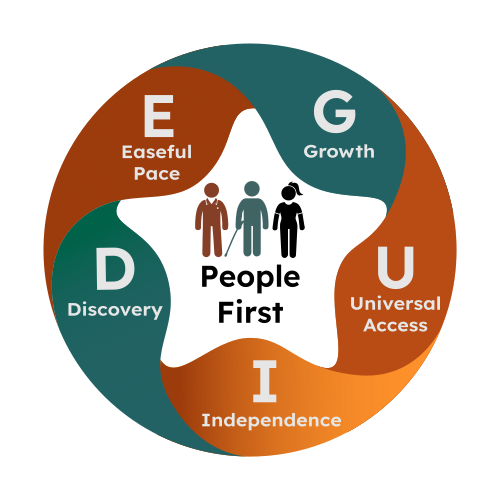
- G – Growth – Empowering: Build confidence, independence, and self-trust through supportive practice.
- U – Universal Access – Adapted: Design activities so everyone can participate, regardless of ability or vision.
- I – Independence – Liberating: Encourage freedom to explore, move, and engage—without unnecessary limits.
- D – Discovery – Experience / Journey: Focus on the participant’s lived experience, not just outcomes or performance.
- E – Easeful Pace – Slow Down: Allow time for orientation, learning, and safe, comfortable participation.
These values remind us that inclusive fitness is about People First—guiding how we adapt methods, communicate clearly, and support every participant’s experience.
Before the First Session
A quick, informal chat before the first session can help set everyone up for success. This doesn’t need to be detailed or personal—it’s simply a way to understand what might help the participant feel comfortable and supported.
You might gently check in about:
- How they usually get around (e.g., preference for verbal guidance or mobility aids)
- Any past experience with similar activities
- What works best for them in terms of lighting, space, equipment, or communication
- Any worries or preferences they would like you to know about
When in doubt, ask the participant what feels comfortable. Only ask what’s relevant, and always respect their privacy.
Use a simple screening tool such as the Get-Active Questionnaire (GAQ) to identify any health considerations before starting physical activity.
The STEP and TREE Models
The STEP and TREE models are practical frameworks used to adapt sport and physical activities so that people of different abilities can participate meaningfully and safely. These models emerged from broader shifts in how disability sport has been understood and positioned internationally.1 Rather than changing the purpose or outcomes of an activity, both models focus on adjusting how the activity is delivered.2
The STEP Model
The STEP model, developed as part of Youth Sport Trust (UK) resource material, stands for Space, Task, Equipment, and People.2 It provides a simple framework for modifying activities to accommodate the abilities and needs of persons with vision impairment (VI), with adjustments made to one or more of these four elements according to the demands of the activity and the needs of participants.
1. Space (Where the Activity Happens)
- Key Focus for PVI: Create a space that is predictable, orientable, and safe.
- Practical Adaptations:
- Clearly define boundaries using raised tape, rope, string, or mats/floor markings that participants can feel with their feet or hands.
- Reduce the size of the physical activity area to support orientation and success.
- Keep layouts consistent between sessions.
- Remove unnecessary obstacles such as bags, spare equipment, and loose cones.
- Provide a thorough verbal orientation before starting, detailing boundary locations, entry/exit points, and fixed hazards (like pillars, benches, or walls).
- Use auditory reference points such as the coach’s voice, clapping, or a speaker.
- Goal: Participants should be able to mentally map the space.
2. Task (What is asked of PVI)
- Key Focus for PVI: Ensure the task is clear, achievable, and not visually dependent.
- Practical Adaptations:
- Break skills into small, sequential steps.
- Replace “watch and copy” with detailed verbal explanation.
- Use physical demonstration only with consent, allowing participants to feel positions or movement patterns.
- Modify task demands: extra repetitions, fewer opponents, or reduced complexity.
- Allow alternative ways to complete the same outcome (e.g., rolling instead of throwing, walking instead of running).
- Check understanding by asking participants to verbalise the task back.
- Goal: Same learning intention, different access route.
3. Equipment (What is Used)
- Key Focus for PVI: Equipment should maximise contrast, sound, and tactile feedback.
- Practical Adaptations:
- Use audible equipment (balls with bells or ball bearings, sound sources at targets).
- Increase ball size and target size.
- Use high contrast colours against the background (avoid green cones on grass).
- Add tactile markers to equipment (tape on handles, raised dots on weights).
- Modify equipment for control rather than speed (softer balls, slower-moving objects).
- Goal: Equipment provides information through sound and touch, not just sight.
4. People (Who Is Involved)
- Key Focus for PVI: Use people strategically to support independence—not replace it.
- Practical Adaptations:
- Use a buddy system where a peer provides orientation cues, timing, or safety support.
- Consider sighted guides for activities such as running or tandem cycling.
- Ensure guides are briefed on communication and guiding principles, speak with participants (not for them), and always address the participant directly by name.
- Rotate buddies so no one becomes permanently dependent.
- Goal: Support participation while preserving autonomy and dignity.
The TREE Model
TREE, developed through the Australian Sports Commission’s Sports Ability initiative, consists of four elements: Teaching Style, Rules, Equipment, and Environment.3 The inclusion of Teaching Style highlights the role of coaches and instructors in adapting communication and instructional approaches to support participation.2, 4 This focus on accessible communication is consistent with findings from educational settings, where students with vision impairment reported that verbalised instructions and detailed descriptions supported more independent participation in learning activities.5
1. Teaching Styles (How You Teach)
- Key Principle: PVI rely less on visual cues and more on verbal, tactile, and auditory communication.
- Practical Adaptations:
- Use clear, descriptive verbal instruction instead of “watch me” demonstrations. Describe body position, movement pathways, timing, and direction explicitly.
- Where appropriate, provide verbal feedback during movement rather than only at the end, tailoring the timing and amount of feedback to PVI’s preferences.
- Use tactile guidance or modelling only with consent (e.g., gently positioning feet for a squat or allowing the PVI to feel a movement).
- Introduce audio cues (clapping, counting, calling names) to orient movement.
- Break skills into small, sequential steps.
- Use peer support or sighted guides if requested by the student.
- Never assume the PVI has seen movements before—describe “basic” skills in detail.
- PVI-Informed Teaching Tip: Always speak to the PVI, not to an assistant or guide, and say the participant’s name before giving directions.
2. Rules (How the Game or Task Works)
- Key Principle: Rules can be adapted to improve access, safety, and success, without reducing learning value.
- Practical Adaptations:
- Prioritise safety-first rules (check medical restrictions with PVI/caregivers/ophthalmologists). To understand competitive visual tiers, read our overview on IBSA Vision Classification Standards.
- Allow extra time, extra bounces (e.g., tennis), or guide runners.
- Modify scoring or success criteria so outcomes measure skill or effort, not speed alone.
- Reduce background noise so PVI can hear instructions and cues clearly.
- Use sound-based rules (e.g., aiming toward a sound source).
- Offer alternative but equivalent activities if a task presents unavoidable risk.
- PVI-Informed Teaching Tip: Ask the participant which audio cues work best—counting, clapping, tapping, or voice—and adjust accordingly.
3. Equipment (What You Use)
- Key Principle: Equipment should support visibility, touch, and sound.
- Practical Adaptations:
- Use colour-contrasting equipment against the background (e.g., yellow ball on a white floor, dark cones on grass).
- Add audible elements like bell balls or speakers at target points.
- Modify size (larger balls, bigger targets), speed (slower-moving objects), and shape (easier to grip or track).
- Add tactile markers like tape, raised lines, ropes, or spot markers.
- Label equipment with tactile or raised indicators (e.g., on weights).
- Ensure fitness professionals/coaches wear high-contrast clothing.
- PVI-Informed Teaching Tip: Ask PVI which colours they see best—colour preference varies widely among PVI.
4. Environment (Where the Activity Happens)
- Key Principle: A well-prepared environment reduces anxiety, disorientation, and risk.
- Practical Adaptations:
- Ensure the area is well lit (avoid glare and harsh sunlight), tidy and clutter-free, and consistently set up week to week.
- Allow time for orientation and familiarisation before activities begin.
- Mark boundaries using high-contrast tape, tactile lines or cones, and audible reference points.
- Reduce unnecessary noise (turn off music when giving instructions).
- Clearly describe hazards, fixed obstacles, and entry/exit points.
References
-
- Kiuppis F. Inclusion in sport: disability and participation. Sport in Society. doi.org/10.1080/17430437.2016.1225882
- Black K, Williamson D. Designing inclusive physical activities and games. In: Cereijo-Roibas A, Stamatakis E, Black K, eds. Design for sport. Aldershot: Gower; 2011. p. 195–224.
- Australian Sports Commission. Using TREE [Internet]. Canberra: Australian Sports Commission; [date unknown] [cited 2026 Sep 2]. Available from: https://www.ausport.gov.au/schools/resource-hub/sports-ability/using-tree
- Lowery M. TREE for Fitness: Using a Physical Activity Modification Tool as a Fitness Professional. PALAESTRA. 2025;39.
- Whitburn B. ‘A really good teaching strategy’: Secondary students with vision impairment voice their experiences of inclusive teacher pedagogy. British Journal of Visual Impairment. 2014;32(2):148-56. doi.org/10.1177/0264619614523279
Watch: The Vision Behind Inclusive Pilates
See how fitness professionals are transforming lives through inclusive Pilates. Watch how preparation and clear communication empower participants with visual impairments to confidently navigate group classes.
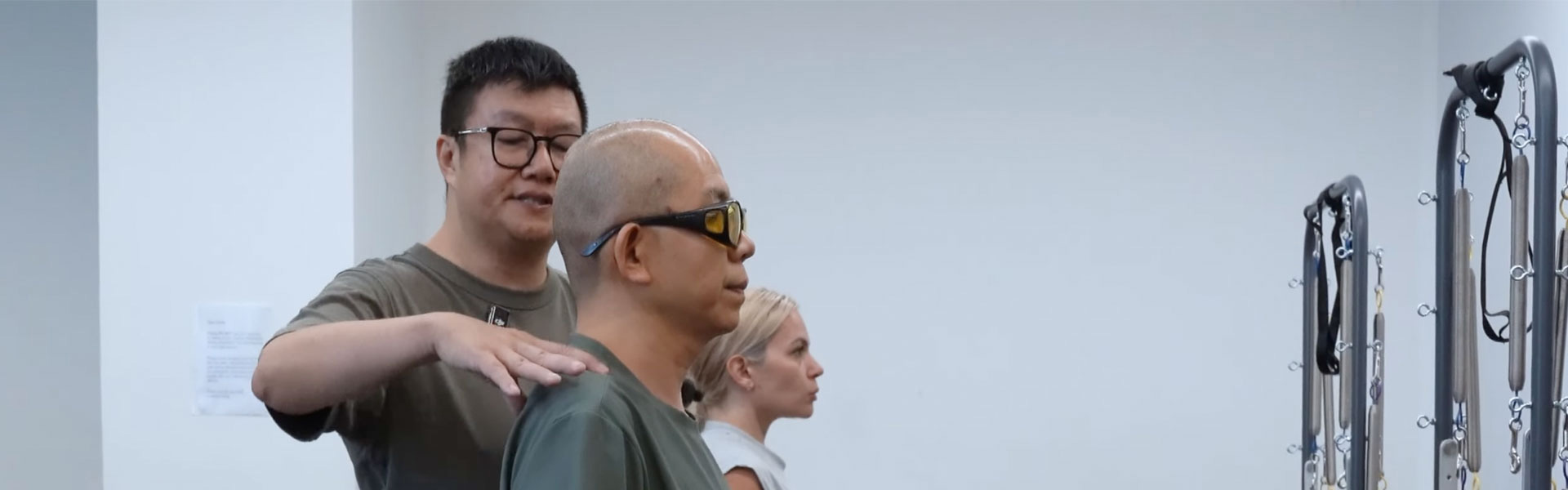
Video Description: A fitness professional stands next to a visually impaired man who is seated on a Pilates reformer machine. The instructor is gently guiding the man’s arm movements, ensuring proper form and alignment. The studio is bright and open. The video explores how clear verbal instruction and tactile guidance can make Pilates accessible and safe.
Duration: 4 mins